
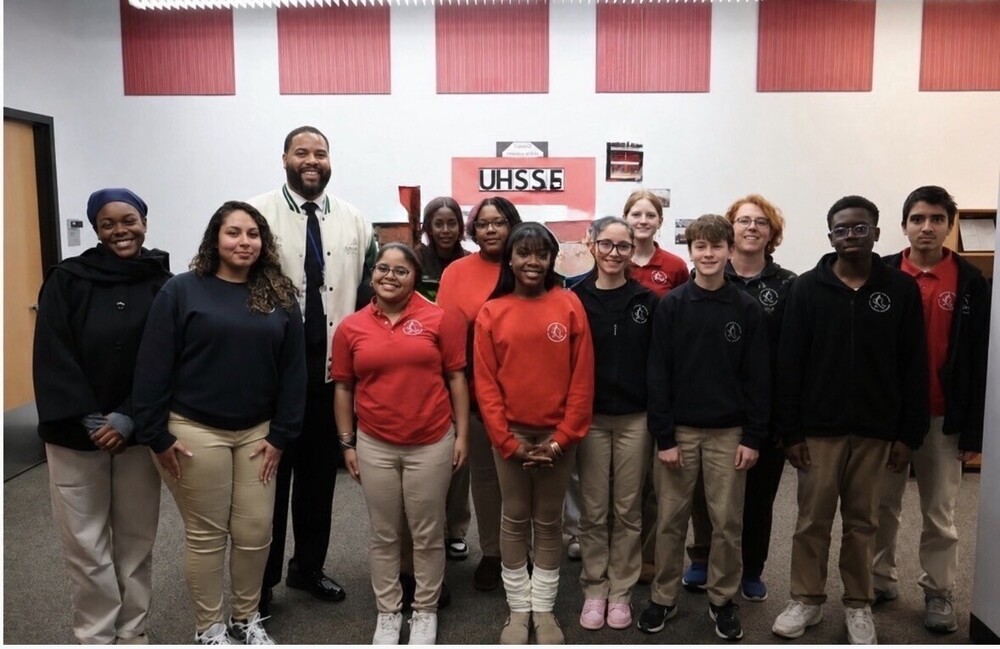
Class of 2025 University High School of Science and Engineering Graduate, Liam McCusker is on the Dean's List at Central Connecticut State University where he is a prolific reporter for the CCSU newspaper, the Recorder. He wrote this tribute to his former UHSSE principal, Sean Tomany who retires this year, and to the valient work of the UHSSE Social Justice League in advocating for free bus passes for CT high school students.
Principal Tomany's Retirement from Hartford Public Schools
After nearly three decades in education, University High School of Science and Engineering Principal Sean Tomany will be retiring at the end of this school year.
Tomany had not initially planned on becoming an educator. When he was 20 years old, he was unsure what career he wanted to pursue. During a family reunion, one of his uncles asked if he had ever considered becoming a teacher. He was really good with his younger cousins. Seeing him supervising Wiffle ball games and other activities prompted his uncle to suggest looking into becoming a summer camp counselor.
“I went up to a summer camp in Maine and was a camp counselor and the baseball coach, and I was like ‘I love working with kids’ and having an impact on their lives,” Tomany said.
Finding his passion for working with children, Tomany went to Manchester Community College for his degree and later got his first teaching job at Weaver High School in 1998 as a history teacher.
Tomany added that he came to Hartford Public Schools after he did not get a teaching position in West Hartford Public Schools. He was later granted an interview with Hartford Public Schools which led to him becoming a long-term sub at Hartford Public High School and Burr Middle School, and landed a history teaching position based on the work he did at those two schools.
Tomany noted that one of the biggest challenges he has faced while working in education is that not everyone agrees on what is the best way to serve the students.
“There can be a lot of politics involved in a big district like this,” Tomany said.
Tomany added that he is always proud of the staff and students that he has worked with throughout his time in the district. He recently had the opportunity to talk with a former student who chose to pursue a nursing career.
“It’s those little things that allow you to watch and see the impact that you’ve had on a student’s life,” Tomany said.
Tomany added that UHSSE is a very small community where everyone knows each other.
Tomany noted that he has developed a leadership style of making sure that he surrounds himself with people on his team who may not have the same opinions as him which allows for meaningful discussions on what is best for the students.
“My leadership team is made up of five people who are all different,” Tomany said.
In the day-to-day work environment at UHSSE, Tomany’s leadership style has made him invaluable to his staff.
“At the end of the day, Tomany has simply made me a better person,” UHSSE Vice Principal Jennifer Todisco said.
Before coming to UHSSE, Todisco worked as an English teacher in Coventry Public Schools where she and Tomany first met, and worked together for two years. Before he joined the district, the school that she was working at had had several turnovers in administration over the course of eight years, and she felt that he brought continuity to the school and believes that he truly works hard every day to do what is best for the kids.
Todisco went on to say that she joined UHSSE after she called Tomany while she was stressed out from the environment in Coventry, and Tomany informed her that there was an open English teacher position at UHSSE which she held for roughly 10 years before she was promoted to vice principal beginning in the 2023-24 school year.
Todisco added that Tomany began mentoring her for leadership roles years before she was promoted.
“I would say that training began within the first year of me coming to UHSSE,” Todisco said.
Both Todisco and Tomany believe that the core mission of every educator should be to work in service of the child.
“The beauty of my job is that every decision I make is couched in what I believe is best for kids,” Tomany said.
Todisco remembers that throughout his tenure, Tomany has made every staff member set high goals for themselves every year, which she said is very hard to reach 100% of those goals.
“Just because you might not be able to reach the goal, you should still try to reach 100 percent,” Todisco said.
Todisco mentioned that under Tomany, UHSSE has been a student-centered and family-first environment both at UHSSE and at home.
“If your child has a game or graduation you better go to that,” Todisco said.
The clearest stories that have stood out to Todisco about Tomany’s leadership include his advocacy to secure free city bus passes for every high school student in the state, always demanding the best from students, which includes taking early college classes, and he even brings bottled water in for students who may not have access to water bottles during the day.
“I think the best example is how many students graduate from UHSSE having taken at least one early college class,” Todisco said.
Todisco added that Tomany has left an indelible mark on the UHSSE community.
“Everyone will miss the fact that in a district where it is very easy to get lost, Tomany fought for every employee and every student and what was best for the school,” Todisco said.
Tomany is unsure what the next chapter of his life has in store for him. He will be spending a month in Italy this September and has received several offers, including opportunities to serve on administrative boards, and the University of St. Joseph has contacted him about potentially starting an administrative program on their campus.
Tomany recounts waking up in the middle of the night and wondering what decisions he could have made differently to be in the best interest of his students. He is looking forward to getting some rest in his retirement but is open to a diversity of roles that may come his way.
Tomany’s legacy will be told for many years according to his colleagues.
“I think Tomany’s legacy will be the lives of everyone he has changed and how they take that out into the world,” Todisco said.
Future of free bus passes for high school students uncertain as pilot program ends
By Liam McCusker | Central Connecticut State University
Oluwaseyi Oluborode, a senior at University High School of Science and Engineering in Hartford, took a yellow school bus to get to her high school on weekdays this year. But this isn’t the only bus she uses.
“I’m involved in a lot of different programs and extracurricular activities that are based in Hartford,” Oluborode said, “and so the city bus has allowed me to participate in those activities that I would not have been able to without it, because my parents work throughout the day.”
Oluborode also had a job in Hartford at the beginning of her senior year, which added to her time on city buses, and she said she knows some students who are even more dependent on city transportation. According to district policy, students who live within two miles of their school in Hartford are not eligible to take the school bus and must rely on city transportation.
With the imminent end of a recent bus pass pilot program for Hartford and New Haven public high school students, and uncertainty over the terms of a replacement grant program, many students are waiting to see whether they will continue to be able to take the city bus to school for free next year.
The cost of taking the city bus can add up quickly. The state’s Department of Transportation website shows that, for youth ages 5 to 18 years old, a single two-hour pass costs $1.40, an all-day pass costs $2.80 and a 10-day pass costs $12.60.
UHSSE Principal Sean Tomany said he became aware of the issue when a free fare program set up during the COVID-19 pandemic expired in April 2023.
“It is inequitable that our Hartford students have to ride the city bus while suburban students get to ride the yellow school bus,” Tomany said.
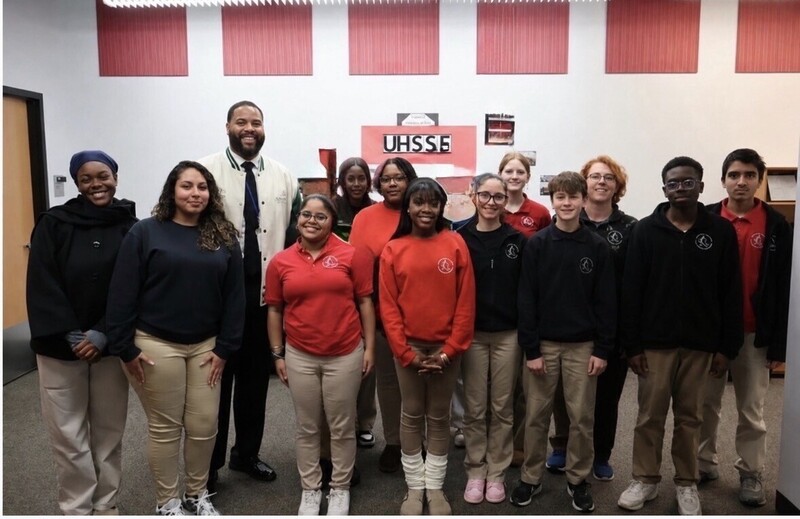
Tomany worked with students during the 2023-24 school year to start the Social Justice League, a student group focused on pushing for free bus passes for all Connecticut high school students. Oluborode has been the vice president of the Social Justice League this year.
Arguing that transportation costs disproportionately affect students in urban districts, such as Hartford, the group was able to get financial support for a pilot program in 2024. The state provided funds to the Hartford Public Schools Board of Education to purchase bus passes for every student in the district for the 2024-25 school year. The program was then extended through the 2025-26 academic year.
Tomany said he handed out the last of the bus passes during the first week of June.
A new law signed by Gov. Ned Lamont on May 27 builds on the pilot program to create a statewide grant program for boards of education to purchase passes for high school students, but Tomany said he won’t know how that money will be allocated until after July 1. He said he may no longer be able to provide free passes to every student who wants one.
A 50% discount on CTTransit buses for all K-12 students was also included in the state budget for fiscal year 2027.
Prior to the passage of the grant program and budget, representatives from Lamont’s office said in an email that he is committed to ensuring that students have access to everything that they need for success.
“Governor Lamont is proud to support funding that helps students access school, work, volunteer opportunities, and extracurricular programs,” Lamont’s Legislative Office and Policy Team wrote.
Eva Zymaris, spokesperson for the DOT, wrote in an email that the agency also supports this proposal and said that it is committed to providing reliable transportation to everyone.
“Providing discounted bus fares for students isn’t just about increasing affordability, it’s about access,” Zymaris wrote. “Reliable transportation ensures people can reach essential destinations like health care, jobs, and school.”
For Oluborode, the discounted fares aren’t enough. She argues that any fare will still be a burden for students.
“Any barrier to the access that a student has to their education should be addressed immediately, and this is a clear barrier,” Oluborode said. “A young person who is fully reliant on the city bus is very unlikely to be able to afford any fare whatsoever, and by making students pay to go to school, you’re effectively discouraging them from going to school.”
Tomany said the state is also potentially missing out on economic activity created by the students using free bus passes. As part of the program, students who received the passes also had to fill out surveys about how they used them, including why and how much they spent or earned as a result of being able to take the city bus. In a final analysis of surveys from this school year, shared by Tomany, roughly 180 UHSSE students spent an average of almost $79,000 per week. And students who used the passes to get to jobs earned about $81,000 per week. Tomany’s analysis shows an economic impact of about $640,000 for the school year.
“They’re spending that money, they’re earning that money, they’re going to restaurants, they’re contributing to the economy,” Tomany said.
Both Tomany and Oluborode are concerned about the impact on students if enough funds aren’t made available for purchasing bus passes when school starts up again in the fall.
“I know it is the main means of transportation for some students because their family either doesn’t have a car or their parents are working constantly,” Oluborode said. “So for them, not having a city bus pass, would mean full disconnection from their community.”
Oluborode said that during the 2023-24 school year, before the pilot program started, she knew of students who dropped out of sports and other extracurricular activities because they had to spend their money on the bus passes needed to get to school. She also predicted that if students did not have enough money for bus passes, they would simply choose to not go to school.
Hartford Public Schools Director of Communications Pedro Zayas said that the district is committed to “expanding learning opportunities and removing barriers for students, families, and educators.” He said subsidizing transportation costs is one way to do that.
“A meaningful way to enhance engagement for HPS students is to provide access to bus passes for afterschool programs and activities,” Zayas wrote in email.
Zayas added that providing transportation to students at no cost would likely increase participation in a number of school activities and provide more access to educational resources in the larger community, such as museums, libraries, and internships, but substantial state investment would be needed.
Hartford Public Schools officials say that covering passes in their own budget is not feasible, especially because they already have $7,072,209 for regular transportation and $32,008,179.24 for curb-to-curb transportation in their fiscal budget for the 2026-27 school year.
The Social Justice League continued to meet with lawmakers this year, and while they were unable to get support for free fares for students, Oluborode thought their advocacy had made some difference. She said she still hopes state leaders will support the idea of free bus passes as an investment in the students’ futures.
“Taxes are supposed to go to things that help people collectively and this is no different,” Oluborode said. “Urban youth are worth the investment. They deserve access and opportunities for education.”
See the article in the CT Community News here.